Autonomous Solutions
Most de-escalation training happens on a screen. ADRT is a training robot that stands in the room.
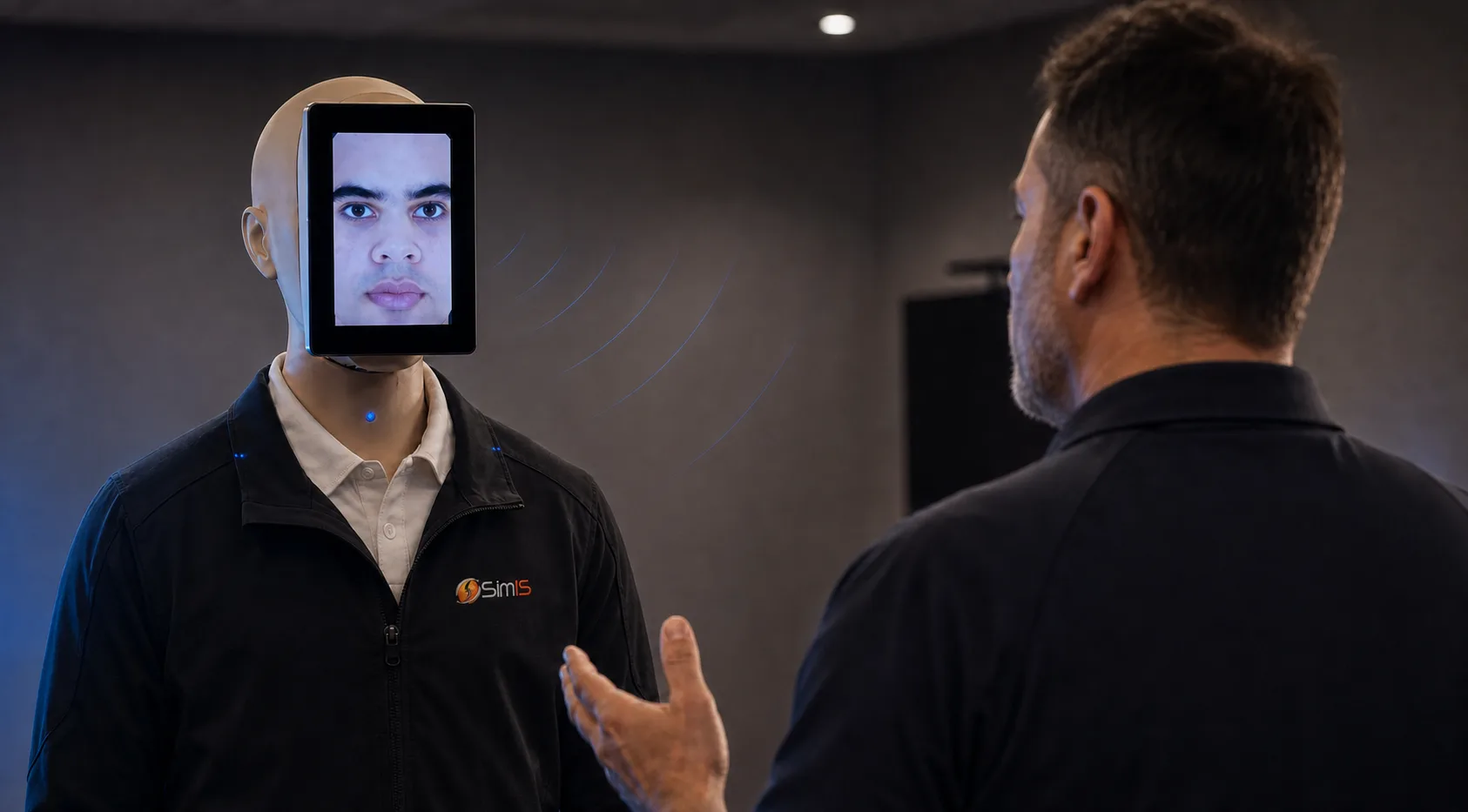
A human-like robotic trainer with voice interaction, physical tracking, and scenario-driven behavior, giving officers repeatable, measurable practice against a subject that talks back.
Autonomous De-escalation Robotic Trainer
Most de-escalation training happens on a screen: a pre-programmed video with a branching menu, no real conversation, and no consequence for getting it wrong. ADRT is a human-like robotic trainer that stands in the room instead, giving officers repeatable, measurable practice against a subject that actually talks back.
See ADRT in Action
A trainee steps into the room, and the robot talks back, tracks their movement, and reacts to how the conversation actually goes. This is de-escalation training without a script.
Filmed during an actual training session, not a staged demo. This is the baseline interaction every ADRT session runs on.
What ADRT Does
Screens can't hold a conversation. Live actors can't scale, and they're never quite consistent from one session to the next. ADRT is built to close both gaps at once.
A Screen Can Only Play Back. ADRT Talks Back.
Branching video is the industry standard everywhere else: pick a path, watch a clip, hope the trainee clicked the right option. That's still just a menu. ADRT skips it entirely. The trainee has an actual conversation, and the robot's response depends on what they say and do in the moment, not which button they pressed.
Built on Real AI/ML, Not a Script
ADRT's behavior runs on the same AI/ML practice behind everything else SimIS fields, trained on known behavioral patterns from real incidents, not a fixed decision tree. See how SimIS builds AI/ML for more on the practice behind it.
A Simulator Can Render a Subject. It Can't Put One in the Room.
ADRT stands at a real distance from the trainee, and that changes what's being trained: how close to get, where to stand, when to step back, when to bring a second officer forward. Proxemics isn't an option in a scenario menu. It's the judgment the officer is there to practice, and it only exists when there's something physically present to approach.
Because ADRT is in the room, everyone in it sees the same subject with their own eyes. Contact and cover work the way they do on the street, an instructor can stop the scenario and point at what just happened, and no one has to put on a headset. The caster base moves ADRT into the rooms an agency already trains in, so scenario-based training runs where the work happens instead of in a dedicated simulator bay.
And a robot that runs four hours on a charge doesn't get tired, doesn't improvise, and doesn't have to be scheduled. The same scenario runs the same way for the twentieth trainee as it did for the first, which is the one thing you can't ask a live role player to do.
ADRT is one of several platforms in our Autonomous Solutions practice.
Specifications
| Subject | Realistic mannequin, interchangeable across ethnicities, genders and clothing. |
|---|---|
| Face | An integrated display renders the face, its expressions and lip-sync. |
| Speech | Integrated speakers simulate speech. |
| Dialogue | A microphone and dialogue system carry a conversation with the trainee. |
| Gesture | Mechanical arms with gesture capability. |
| Behavior | Robotic software controls motion, and artificial intelligence generates the human-like behaviors. |
| Sensing | Lidar senses the surroundings, so the robot responds to the officer with both voice and movement. |
| Movement | Robotic sensors for advanced movement. |
| Runtime | Integrated batteries and charging for four hours of operation. |
| Mobility | Caster wheel base for moving indoors. |
| Control | Mobile app for scenario selection, remote control and feedback. |
| Scenarios | Updated on an ongoing basis as law enforcement needs change. |
| Status | Patent pending. |
Integration details are in the brochure below, built for the training officers and program managers who need the full picture before they need the demo.
Frequently Asked Questions
What is a de-escalation training robot?
How is ADRT different from screen-based training?
Does ADRT use scripted responses?
Who is ADRT for?
Where does ADRT fit in a training program?
Is ADRT for academy training?
Reach Out
Want to learn more about how ADRT can serve your training requirement? Ask about specifications, pricing, deployment timelines, or how ADRT fits alongside the rest of our Autonomous Solutions practice, and we'll respond quickly.