Human Type Targets
Paper targets don't move. HTT is a humanoid robotic target that does.
HTT is a mobile, trackless robotic target that moves like the threat it stands in for, deployed across live-fire ranges without rails or fixed infrastructure.
Human Type Targets
The Human Type Targets (HTT) system replaces the static, predictable range with an adversary that moves like one. HTT is a mobile, trackless smart target deployable across whatever terrain the mission calls for, indoors or out, and it doesn't wait for a shooter to find it: preprogrammed scenarios, Location of Hit and Miss (LOMAH) data capture, and built-in After-Action Review turn every live-fire exercise into training data, not just spent rounds.
In range terms, HTT is a self-propelled trackless moving infantry target. It answers the same training requirement a stationary infantry target on a target lifter is bought to meet, without the fixed emplacement that equipment needs, and unlike a pop-up it is never in the same place twice.
See HTT in Action
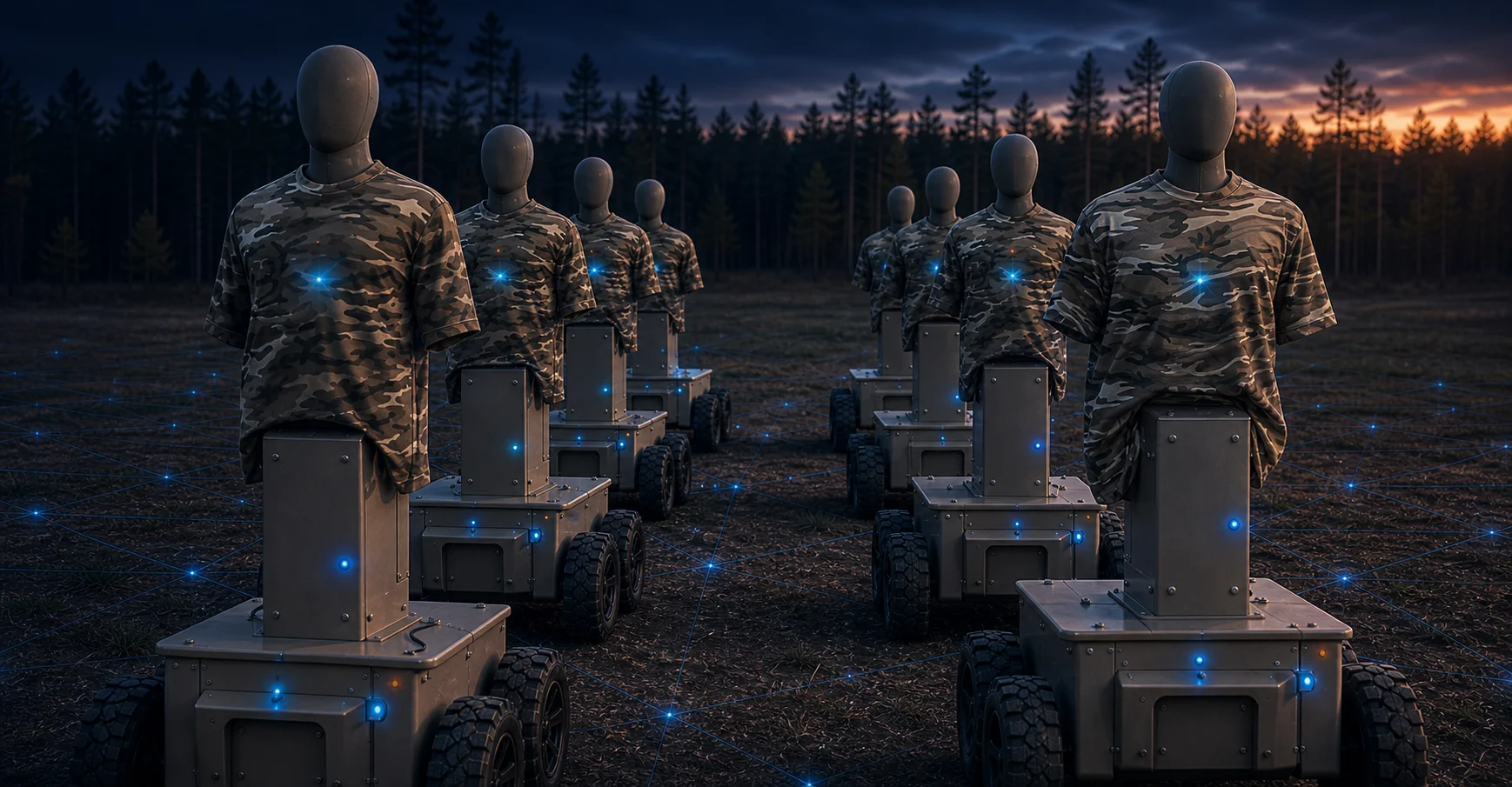
Four HTT units moving independently across open terrain, holding formation, and reacting to the scenario in real time. This is what a live-fire range looks like when the targets stop waiting to be found.
Filmed on an actual training range, not a demo stage. What you're watching is the baseline behavior every HTT ships with.
The Problem With Static Targets
Every fixed target teaches the same lesson: where to aim at something that isn't going anywhere. Real threats move, hide, and react, and a range that can't replicate that isn't testing marksmanship, it's testing memorization.
What HTT Does
Every capability below exists to answer one question: does the target hold up to a real exercise, or does it need babysitting between shots? HTT is built to run the scenario, not interrupt it.
Built on Open Standards, Not Proprietary Lock-In
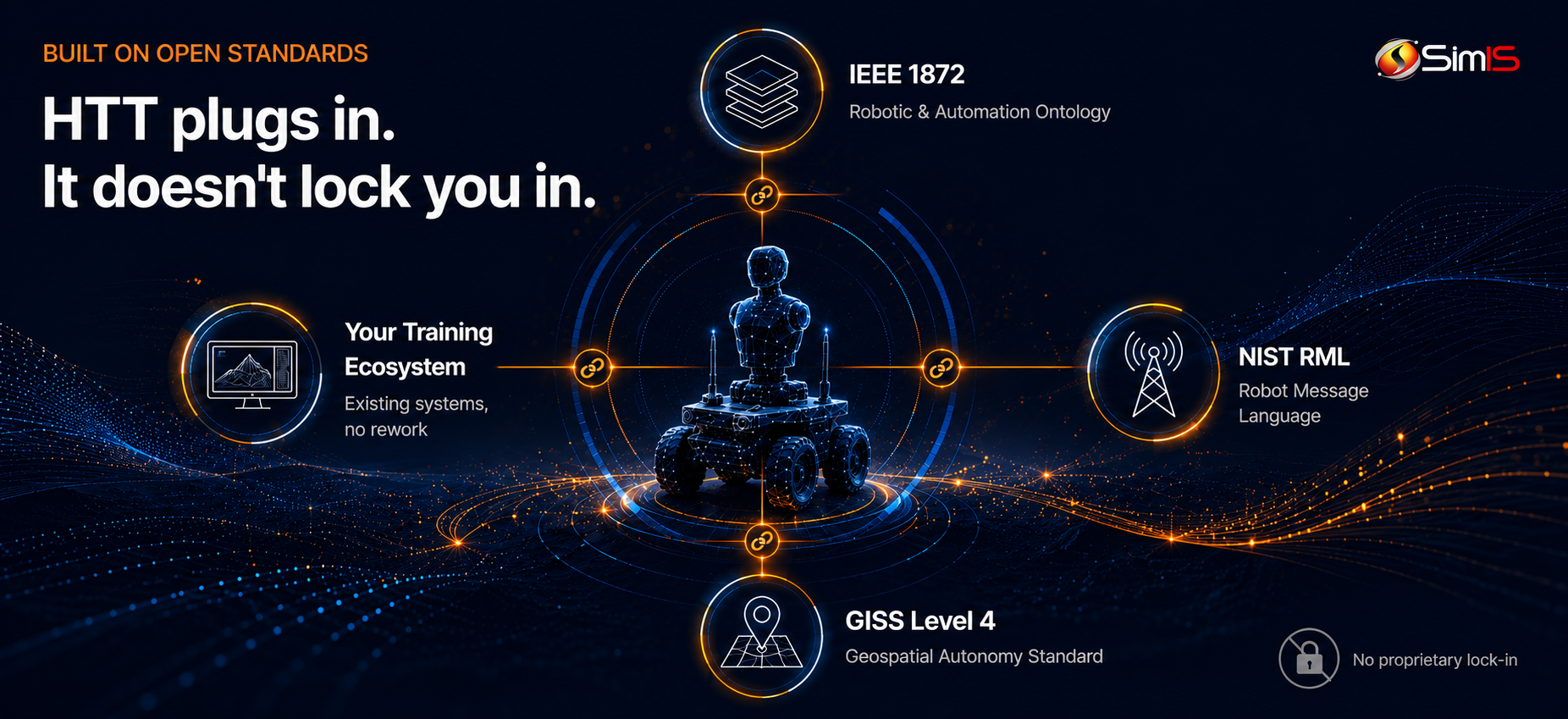
HTT supports Geospatial Infrastructure and Standards for Autonomous Vehicles through level 4, and complies with the IEEE 1872 robotic and automation ontology standard and NIST robot message language guidelines. In practice that means one control interface across a mixed fleet, integration with the range management system you already run, and no vendor-specific operator retraining when you add targets. Your range is not locked to a single vendor's proprietary control scheme, and the targets you buy next do not have to come from us.
 Close
CloseFour standards, one target. No proprietary control scheme to work around.
Why It Matters
None of this matters if the target can't survive the training day. HTT is built for the range, not the showroom, so the advantages below show up in throughput and realism, not a spec sheet nobody reads before the exercise.
HTT is one of several platforms in our Autonomous Solutions practice.
Specifications
| Hit detection | A sensory system detects projectiles passing through the torso. |
|---|---|
| Hit response | The torso falls back 90 degrees on a lethal hit, and distinguishes lethal from non-lethal. |
| Armor | AR500 on the base mobility platform, vertical body support and torso arm. |
| Rated to | Rounds up to .338 Lapua. |
| Torso | Self-healing ballistic polymer, dressed in training-specific clothing. |
| Reset | Returns to the firing position remotely. No walk downrange. |
| Drive | All-wheel continuous drive. |
| Terrain | Multi-terrain and all-weather: dirt, sand, gravel, grass and mud. |
| Ground clearance | Four inches. |
| Gradient | Up to 15 degrees, uphill, downhill and across. |
| Navigation | Integrated GPS for semi-autonomous scenario build and execution. |
| Control | One remote control unit drives eight robots per channel, 24 in total. |
| Cooling | Armored ventilation for the interior electronics. |
| Training data | Location of Hit and Miss (LOMAH) capture, with After-Action Review built in. |
| Standards | IEEE 1872 robotics and automation ontology, NIST robot message language, and Geospatial Infrastructure and Standards for Autonomous Vehicles through level 4. |
| Status | Patent pending. |
Sensor detail and integration requirements are in the brochure below, built for the program offices and range officers who need the full picture before they need the demo.
Frequently Asked Questions
What is a humanoid target?
How is a robotic target different from a pop-up target?
Can the targets move while being shot at?
Does HTT record where each shot landed?
Does the target have to be reset by hand between scenarios?
How does HTT compare to a target lifter?
Can HTT tell a lethal hit from a non-lethal one?
Reach Out
Want to learn more about how HTT can serve your training requirement? Ask about specifications, pricing, deployment timelines, or how HTT fits alongside the rest of our Autonomous Solutions practice, and we'll respond quickly.